

































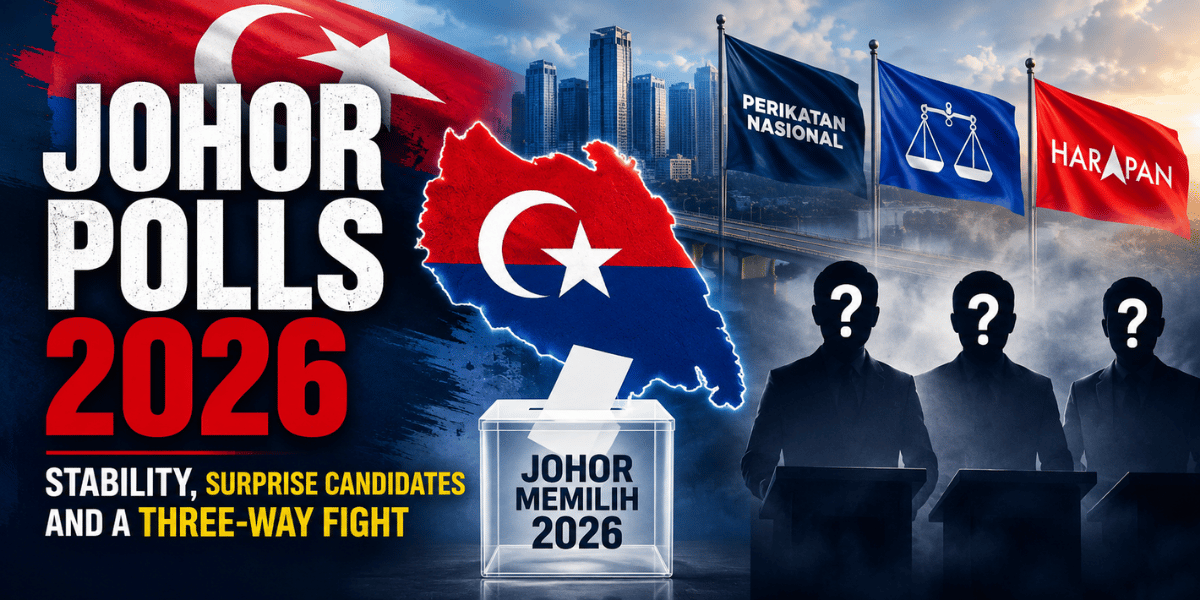
JOHOR BAHRU – With polling day on 11 July drawing closer, Johor’s state election is shaping up to be one of the most closely watched political contests in Malaysia this year.
Beyond the battle for all 56 state seats, the election is also emerging as a key test of public sentiment towards the country’s major political coalitions ahead of the next general election.
Unlike the 2022 Johor election, where Barisan Nasional (BN) secured a landslide victory and returned to power with a commanding majority, this year’s contest presents a different political landscape.
Candidate selections, internal party negotiations, leadership questions and shifting voter expectations have combined to make the campaign far more unpredictable.
BN First Out of the Blocks
BN became the first major coalition to complete its candidate announcement, unveiling a full slate of 56 candidates while reaffirming its confidence in caretaker Menteri Besar Onn Hafiz Ghazi as the face of its campaign.
The coalition is once again banking on its message of political stability, continuity in governance and economic growth, arguing that Johor has regained investor confidence and development momentum over the past four years.
However, the announcement was not without drama.
Several incumbent assemblymen were omitted while a number of fresh faces and experienced politicians were brought into the line-up, signalling that BN was prepared to make difficult decisions in pursuit of retaining the state.
Perhaps more significantly, Onn Hafiz declared that BN would not form any post-election coalition with other political parties should it secure another mandate, a message clearly aimed at portraying the coalition as capable of governing independently.
PH Bets on Fresh Faces
Pakatan Harapan (PH), meanwhile, has finalised its own candidates after earlier confirming the distribution of seats among its component parties, with PKR contesting 20 seats, Amanah 19 and DAP 17.
Although the coalition publicly projected confidence throughout the selection process, political insiders suggested that several candidates were replaced during the final stages following intervention from the central leadership.
The last-minute adjustments reflected the delicate balancing act between grassroots preferences, party hierarchy and electoral strategy.
Among the names drawing national attention is former Education Minister Dr Maszlee Malik, whose return to the Johor political stage has reignited speculation over whether he could once again emerge as PH’s Menteri Besar candidate should the coalition pull off an upset.
At the same time, PH Johor chairman Datuk Seri Dr Zaliha Mustafa has chosen not to contest, instead assuming the role of campaign strategist responsible for coordinating the coalition’s statewide election machinery.
PN Faces Uphill Battle
Perikatan Nasional (PN), led by Bersatu and PAS, enters the election seeking to improve on its modest performance in the previous Johor polls.
While the coalition continues to rely on its established grassroots network and loyal support base, recent public disagreements among some of its component leaders have inevitably attracted attention and raised questions over internal cohesion.
Whether PN can translate national opposition sentiment into meaningful gains in Johor remains one of the biggest unknowns heading into polling day.
Candidate Selection Dominates Headlines
If there has been one recurring theme throughout the campaign period so far, it is the intense focus on candidate selection.
Across multiple political parties, several expected candidates were dropped, replaced or shifted to different constituencies at the eleventh hour.
The developments highlighted the often delicate relationship between grassroots divisions eager to reward local leaders and central party leadership focused primarily on winning seats.
Although such negotiations are not uncommon in Malaysian politics, the scale of speculation surrounding Johor’s candidate selection process has made it one of the defining stories of this election.
Federal Partners Become State Rivals
One of the more intriguing aspects of the Johor election is the political reality that BN and PH remain partners in the Federal Government while competing directly against each other at the state level.
The unusual arrangement has produced a campaign unlike any other, with both coalitions aggressively courting the same pool of voters while avoiding personal attacks that could jeopardise their working relationship in Putrajaya.
For voters, the election presents an interesting contrast between national cooperation and state-level political competition.
Key Battlegrounds
Political observers believe several constituencies could determine the overall outcome of the election.
Seats such as Puteri Wangsa, Kempas, Bukit Batu, Bukit Naning, Pemanis, Senggarang and Tenggaroh are expected to witness closely fought contests and may provide early indications of whether PH can make significant gains or whether BN will successfully defend its dominance.
Urban and semi-urban constituencies, in particular, are expected to become the main battlegrounds where voter turnout and swing votes could prove decisive.
More Than Just a State Election
The Johor election carries significance far beyond the state’s borders.
As one of Malaysia’s economic powerhouses and UMNO’s traditional stronghold, the result is likely to influence national political narratives heading into the next general election.
A convincing BN victory would reinforce the coalition’s claim that it remains the dominant political force in Johor. A stronger-than-expected showing by PH would strengthen its argument that voter confidence continues to grow despite contesting independently. Meanwhile, any meaningful gains by PN would demonstrate that the opposition remains capable of challenging both governing coalitions in key states.
Ultimately, Johor 2026 is no longer simply about deciding the next state government.
It has evolved into a political barometer, testing leadership credibility, coalition strength and voter confidence at a time when Malaysia’s political landscape continues to undergo significant change. -MalayaDailyToday