


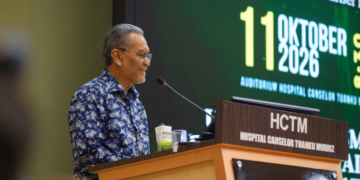

































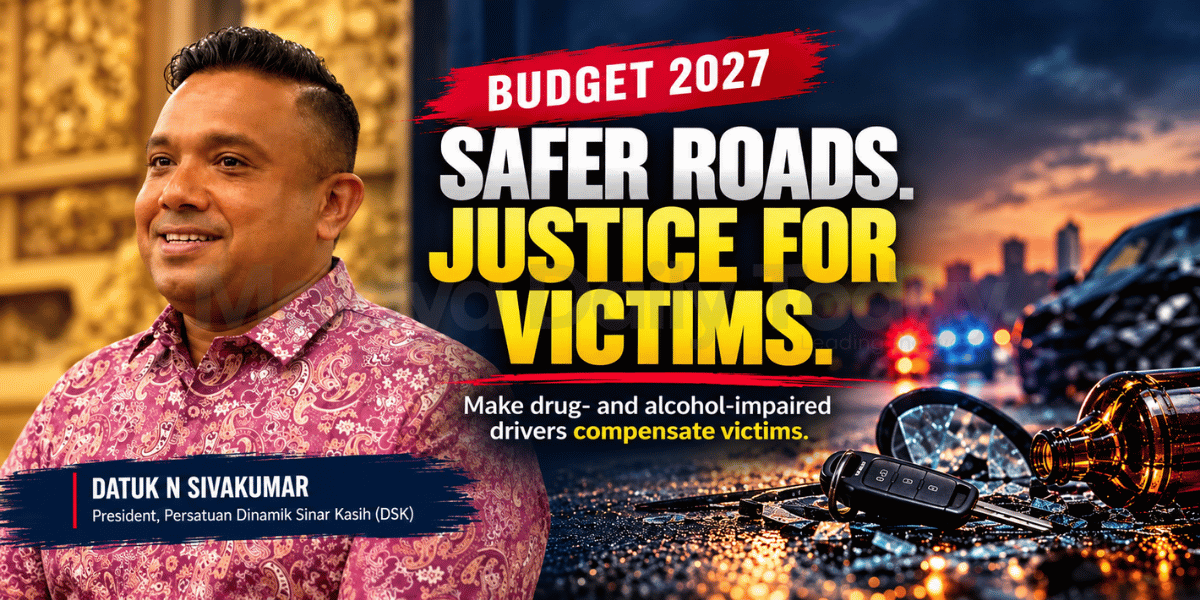
KUALA LUMPUR – The Government’s proposal to require drivers under the influence of drugs or alcohol to compensate victims of road accidents is a welcome step towards strengthening accountability and protecting victims’ families, said Datuk N Sivakumar.
The President of Persatuan Dinamik Sinar Kasih (DSK) said the proposal announced by Prime Minister Datuk Seri Anwar Ibrahim during the tabling of Budget 2027 on October 9 reflected an important commitment to ensuring that victims and their families receive appropriate redress.
However, Sivakumar stressed that compensation must complement, rather than replace, criminal punishment, stronger enforcement and preventive measures to stop impaired drivers from endangering other road users.
“I welcome the Prime Minister’s announcement. Families who lose loved ones in accidents involving drug- or alcohol-impaired drivers should not be left to bear the emotional, financial and psychological consequences alone.
“Making offenders compensate victims is an important step towards accountability. However, compensation alone cannot bring back a life. We must also ensure that the law is enforced firmly and consistently, and that every possible measure is taken to prevent similar tragedies,” he said in a statement.
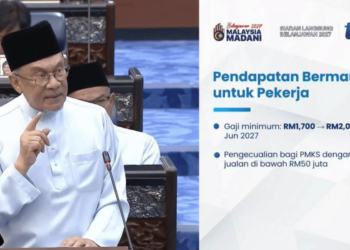
During the Budget 2027 presentation, Anwar announced plans to amend the Road Transport Act 1987 to require drivers under the influence of drugs or alcohol to compensate victims of accidents.
The Prime Minister also disclosed that 28 fatal cases involving drivers under the influence of drugs or alcohol had been recorded up to August 2026.
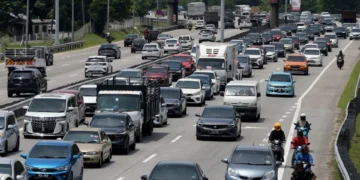
The Government further announced plans to introduce mandatory telematics systems for commercial vehicles to monitor speed, location and risky driving behaviour, with the potential integration of alcohol detection devices before drivers begin their journeys.
Sivakumar said the proposed amendments must be supported by a clear and practical compensation mechanism that takes into account the losses suffered by victims and their dependants.
“The Government must ensure that compensation is not merely a provision on paper. Families need a clear process to seek redress, reasonable timelines for claims and effective mechanisms to enforce payment.
“When a victim loses their life, the family may suddenly lose its main breadwinner. Compensation should therefore take into account not only immediate expenses but also the longer-term financial impact on dependants,” he said.
He also called on the Government to examine whether stronger penalties are needed for offences involving death or serious injury caused by driving under the influence of drugs or alcohol.
“Financial compensation is one part of justice, but criminal accountability remains essential. The law must send a clear message that getting behind the wheel while impaired can have devastating consequences and will not be treated lightly.
“We need a comprehensive approach that combines appropriate punishment, effective enforcement, public education and measures to stop impaired drivers from taking to the road in the first place,” he added.
Bail in fatal e-hailing crash raises concerns
Sivakumar also highlighted the case of Maldivian student Aamina Imeely Nazim, who died in a crash on October 4.
The incident allegedly involved an e-hailing driver who was under the influence of methamphetamine.
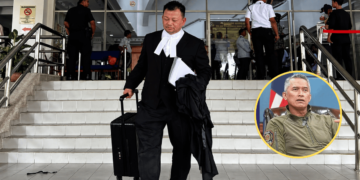
The accused was subsequently charged in court and granted bail of RM9,000 while awaiting further proceedings.
The decision has prompted questions among members of the public about how bail is determined in fatal road accident cases, particularly when drug impairment is alleged.
“Cases involving the loss of life understandably raise strong public concern. When a driver is accused of causing a fatal accident while under the influence of drugs, families and the wider public want to understand how the law applies and what safeguards are in place to protect road users.
“Every case must be assessed according to its own facts, evidence and charges. We must respect judicial independence and the accused person’s right to a fair trial. At the same time, there must be public confidence that the legal framework is capable of addressing the seriousness of these incidents,” he said.
Sivakumar emphasised that bail does not amount to an acquittal or determine the accused person’s guilt. Nevertheless, he urged the relevant authorities to ensure that charging decisions, bail procedures and the application of road safety laws remain transparent and consistent.
He also called for greater public understanding of the distinction between criminal punishment, bail and compensation, noting that each serves a different legal purpose.
Stronger prevention and enforcement needed
Beyond the proposed compensation requirement, Sivakumar proposed several measures that could further strengthen road safety.
These include expanding targeted roadside checks for drugs and alcohol, improving the detection of impaired driving, reviewing penalties for repeat offenders and strengthening the use of technology to prevent drivers under the influence from operating vehicles.
He welcomed the proposed telematics requirements for commercial vehicles, saying technology could play a greater role in identifying dangerous driving patterns and reducing preventable accidents.
“Prevention must be a priority. We should not wait until a family loses a loved one before taking action. Targeted enforcement, reliable screening and appropriate technology can help identify risks before they result in tragedy.
“Drivers who repeatedly endanger others must also be dealt with appropriately under the law, including through licence restrictions where justified,” he said.
Sivakumar further urged the Government to ensure that the proposed reforms address the practical needs of victims and their families, including access to legal assistance, psychological support and guidance on pursuing compensation claims.
He said the implementation framework should also address situations in which offenders are unable to pay, so that families are not left without meaningful recourse after suffering devastating losses.
“The announcement in Budget 2027 is a welcome step towards greater accountability. The next priority is to translate that commitment into effective legislation and enforcement.
“Road safety is not simply about penalties after an accident has occurred. It is about protecting lives, preventing avoidable deaths and ensuring that families who lose loved ones receive meaningful support and justice,” he said. -MalayaDailyToday