











































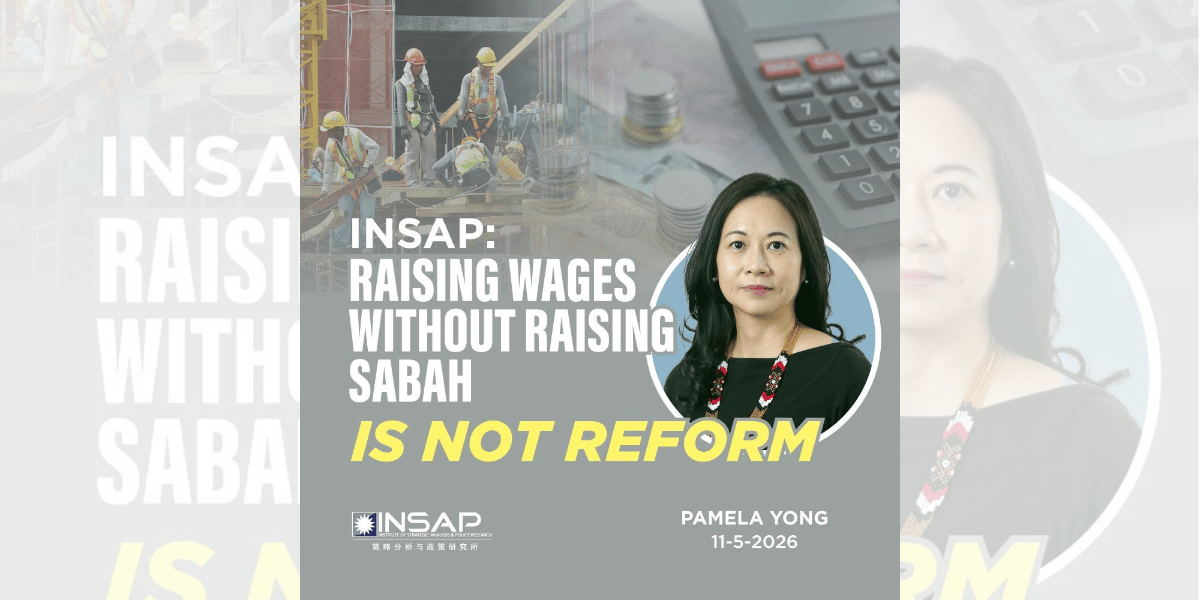
KUALA LUMPUR – The Institute of Strategic Analysis & Policy Research (INSAP) has cautioned the Federal Government against implementing a “one-size-fits-all” wage policy, warning that Sabah could face deeper economic strain if wage increases are not matched with broader structural reforms.
INSAP chairman Datuk Dr Pamela Yong said while the MADANI Government’s target of achieving a RM3,000 minimum wage by 2030 was welcomed in principle, the policy must be supported by stronger economic fundamentals, particularly in Sabah.
She said raising wages without first strengthening productivity, investment and job creation would not amount to meaningful reform.
According to her, Sabah continues to lag behind Peninsular Malaysia in key economic indicators including household income, poverty levels and the availability of high-value industries, resulting in a weaker wage structure compared to more developed states.
“Sabahans have lived with this gap for decades. A wage policy designed without regard to these realities will not close the disparity, but widen it further,” she said in a statement today.
Pamela said the projected minimum wage-to-median wage ratio, also known as the Kaitz ratio, for Sabah under the 2030 wage trajectory was expected to exceed 100 per cent.
She explained this would mean the proposed minimum wage could surpass what the median Sabahan worker is expected to earn, describing it as a warning sign of a fragile wage ecosystem and deep regional imbalance.
“A wage floor that sits above the median is an economy stretched beyond what it can sustain,” she said.
She added that when wage policies move faster than productivity growth and investment expansion, employers may respond by slowing hiring, accelerating automation or shifting towards informal employment arrangements.
“This will make quality jobs even harder to find, especially in states where industrial depth remains limited and high-value sectors are still underdeveloped,” she said.
Pamela stressed that while larger economies in Peninsular Malaysia may be able to absorb the impact due to stronger industrial ecosystems and urban labour markets, Sabah faces higher logistics costs, thinner infrastructure and a narrower industrial base.
She said expecting Sabahan employers to adopt the same wage increases on the same timeline as businesses in the Klang Valley, without parallel economic support, would place an unfair burden on the state.
INSAP also urged Putrajaya to introduce a comprehensive regional economic plan for Sabah alongside any wage reform agenda.
Among the measures proposed were greater investment in infrastructure and logistics, industrial upgrading, targeted skills development and phased implementation based on sector and state-specific economic capacity.
“The dignity of workers is measured not only by wages on paper, but by the availability of sustainable jobs they can actually secure,” she said.
Pamela said wage reform must be designed with Sabah’s realities taken into account to ensure the policy delivers genuine economic mobility and long-term benefits for workers in the state. -MalayaDailyToday